For Christmas we were given a hydroponic aquarium. It’s one of those things that you either love or send a thank you note that says “why would you do this to me?” People give us these things from time to time – things that make your kitchen explode or cover your bathroom in vegetable dye. We tend to love them.
The aquarium is designed to grow micro-greens on top while purifying water for the fish below. It comes with everything except water and a fish. Shortly after Christmas Chris took Sugarplum to the pet store in the big city where she picked out Antler.
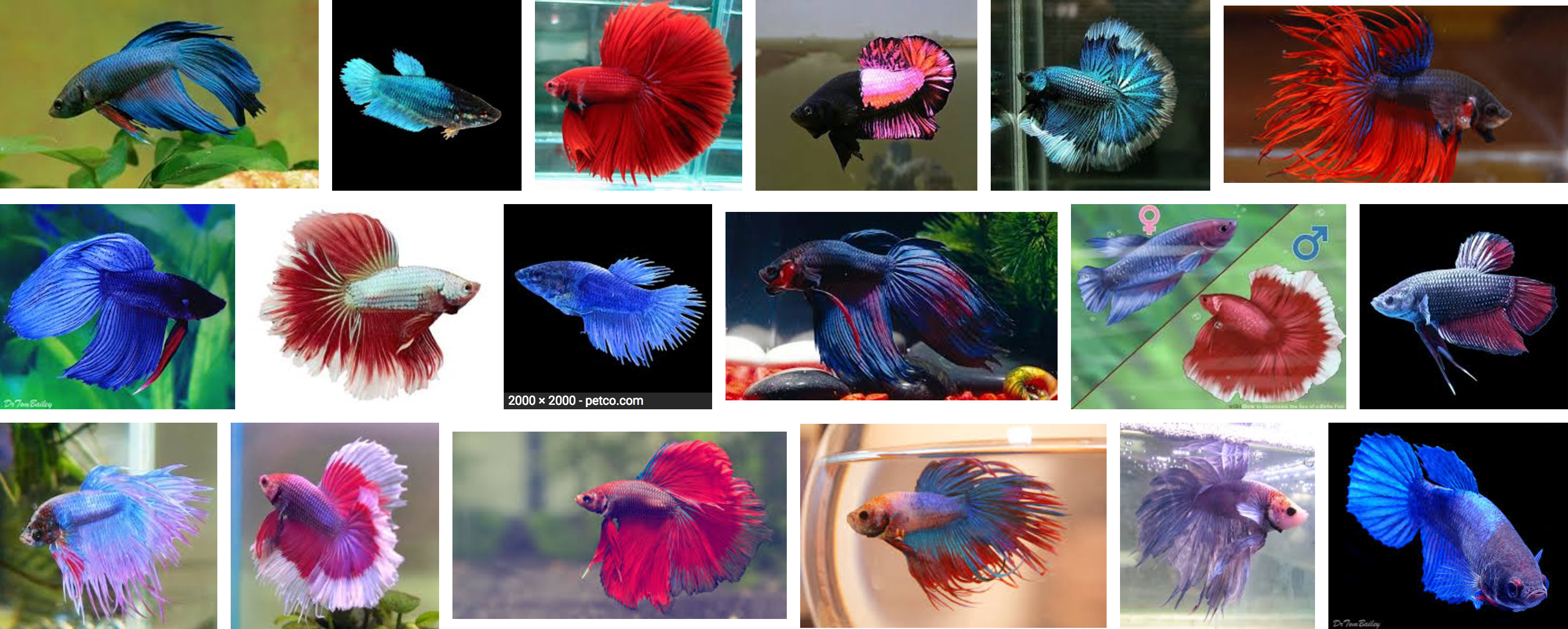
Bettas are beautiful fish. I have had a few over the years and loved their grace and vivid splendor. They come in these crazy colors, as can be seen in a simple Google image search:
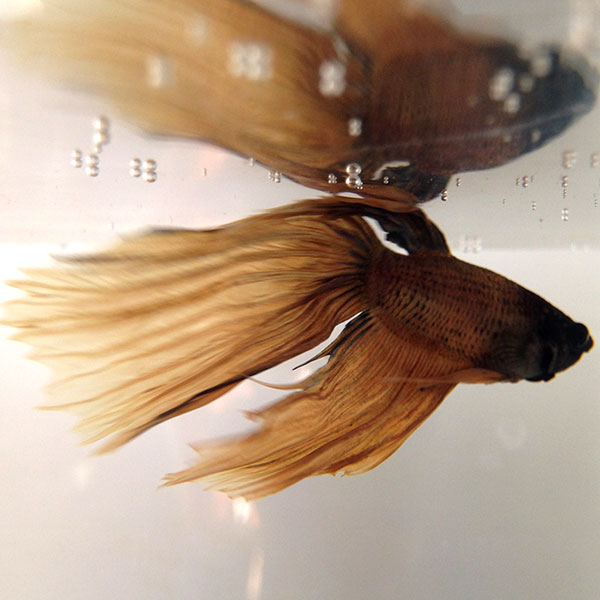
You can imagine my surprise when Antler came home and turned out to be a natural brunette like the rest of us. Out of all the fish, my daughter picked the beige one. That’s really nice, I thought. She brought home the one no one was going to buy.
“He’s Antler,” she said. “He’s supposed to be brown.”
We grew radish greens and wheat grass, most of which we ate or juiced before they turned to brown sludge. We replanted when the first seeds were spent and experimented with different greens with varying degrees of success (read: failure).
Things were going great. The fish was happy, the plants were happyish, and then the aquarium went from passable to an omg-where’s-the-fish? bucket of slime in less than 12 hours. The parallels between Antler and life in our house just never let up.
I went back to the fish store and bought a net and a sponge shaped like a fish because obviously you need a sponge shaped like a fish. I also picked up more food.
Antler does not eat just any fish food. Or maybe he does, but he’s doing great on what came with the Water Garden so I figured we should stay with what’s working. The thing is, the kind he eats come in two versions: regular and color enhancing.
I have puzzled over his color a few times since his arrival. For a little while I thought he might be a juvenile and hadn’t settled on a color yet. Like baby eyes. But could it be all Antler needs is color enhancing fish food?
I agonized over this decision longer than is sane. Antler is Antler. He is supposed to be brown. We love him and let’s face it, the chances of him attracting a mate in our dining room are slim.
Which is a shame, because he is seriously handsome.
Eat your greens. Live your life. Be your own fish.
We had a friend come to the house and take care of everything while we were gone, including feeding our chickens and Antler the hydroponic fish. We did not ask him to take care of Hazel because Hazel is a lunatic and we were not 100% sure she would let our chicken sitter in the house. This is fine for the chickens as they only come in occasionally, but Antler would have pitched a fit.
Hazel was a rescue pup and I wonder sometimes if the places where you leave your dog to go on vacation are reminiscent of where you leave your dog when you just go. So Hazel went to the spa.
When we signed her up we spread the brochures out on the kitchen floor and talked about how it was a place where she could claim her own experience in a supportive, nurturing environment. It was a time to connect with her inner puppy, spark her creativity, and find her peace deep within. We were all really excited about the retreat, including Hazel. Which is to say she at no time peed on the brochures.
Studley went with me to drop her off and was fully invested in the process. So invested, in fact, that he signed her up for all the extra menu items, spa treatments, and relax & renew mind/body workshops while I was in the restroom.
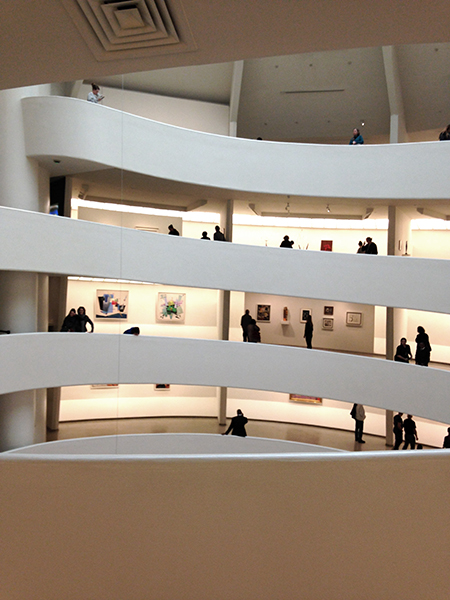
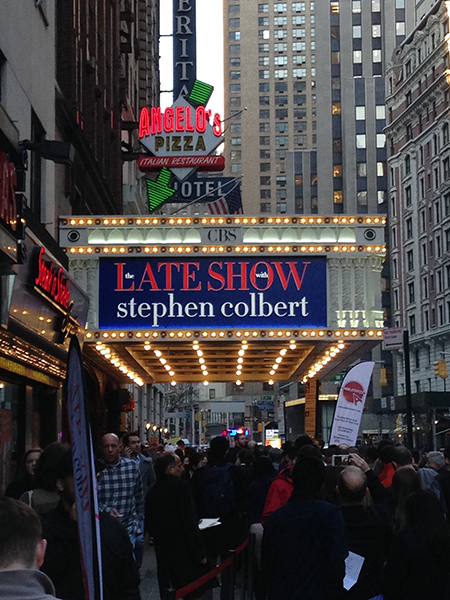
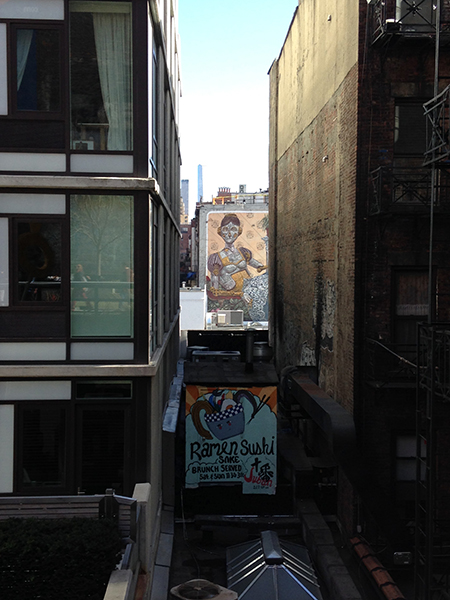
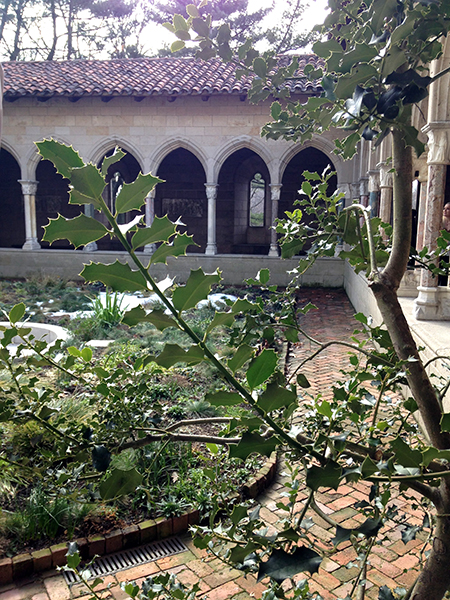
With all the animals accounted for, we went off to New York and walked 175,000 miles. We went to the Cloisters, the Metropolitan Museum of Art, the Guggenheim, the Tenement Museum, The Museum of Modern Art, The Whitney, the Museum of Natural History, and the Breuer Museum.* We went skating in Central Park, walked the Highline, and went to the Late Show with Stephen Colbert. We ate 500 things and then had Indian food delivered because we could.
When we got home we picked up Hazel who now smells like kombucha. And I have to say, as great as it is to collapse from museum fatigue daily and have food delivered to your door, getting hugged by a dog is better.
Not looking down at the Guggenheim
The Late Show with Stephen Colbert, Bradley Whitford, and puppies
From the Highline
I would totally be a monk in these cloisters
I think one of these people belongs to me
*Sugarplum and I spotted the Breuer on our way home from consignment shopping, cruised the gift shop and had mochas in the cafe. Stop judging me.
Given the season, I’ve found myself exploring politically inspired themes. I had a lot of material to chose from – so many operas have been – and continue to be – inspired by political situations.
“Scalia/Ginsberg” is a new opera by Derrick Wang. According to an article in Salon, “Justices Antonin Scalia, with his devotion to the Constitution’s original meaning, and Ruth Bader Ginsburg, more willing to adapt the Constitution to changing times, were ideological opposites and longtime friends with a mutual love of opera.”
I couldn’t find a recording or video for “Scalia/Ginsberg,” but for once I have an actual excuse to play something from “Nixon in China.” I think this particular selection is especially timely. “News has a kind of mystery….”
According to Tim Ashley’s opera guide in the Guardian, Jurgen Flimm’s 2004 Zurich Opera production of Beethoven’s “Fidelio” emphasizes that “the opera is not only a demand for freedom and individual dignity, but is also a reminder of the lengths to which we must sometimes go in order to achieve them.”
Following the 2008 election, Guerilla Opera came out with Curtis Hughes opera “Say it Ain’t so, Joe,” about the vice presidential debates between Joe Biden and Sarah Palin. The opera is described as a musical re-imagining of the 2008 Vice Presidential Debate, along with glimpses of other contemporaneous events and figures – with some fantastical digressions. It goes on to say that it’s not about Palin and Biden as real people, so much as about their public identities as constructed in the imaginations of the American people. It’s intended to evoke the subjective experience of watching the debate, including some emotional twists and turns and musical reflections on the nature of political speech. The libretto is adapted from public records – so the dialog will seem eerily familiar.
There was also an opera about Canadian Prime Minister Brian Mulroney, by Dan Redican. Its premiere was described as an epic failure, but it’s short, sweet, and judging from the trailer, worth the watch.
Also worth the watch is the upcoming movie of Margaret Atwood’s “The Handmaid’s Tale.” The opera version of “The Handmaid’s Tale” by Poul Ruders premiered at the Danish Royal Opera in 2000.
And let us not forget “Powder Her Face,” the explicit opera by Thomas Adès about the “Dirty Duchess”, Margaret Campbell, Duchess of Argyll, whose sexual exploits were the stuff of scandal and gossip in Britain in 1963 during her divorce proceedings. I played the overture on the radio, just to be safe.
Then of course there’s Boris Godunov. Boris comes out of the gate with everything I love about Russian opera. I love the traditional melodies, the bells, the heaps of choruses and the sound of the Russian language. It’s the story of Boris Godunov, obviously, who became tsar when someone had Ivan the Terrible’s heir, Dimitry, killed as a baby. We’re not saying who.
Opera means many different things to many different people, says a New York Times review. One meaning with a long history is “opera as musically accompanied declamation,” which is how ”X (The Life and Times of Malcolm X)” by Anthony Davis struck a reviewer in its formal world premiere at the New York City Opera. X “falls into the category of message theater, and by definition its message will not appeal to all who hear it.” See what you think:
A new opera by Mohammed Fairouz opened at Washington National Opera earlier this month that may or may not be about Trump. According to a Washington Post article, in “The Dictator’s Wife” the attractive wife of an authoritarian political leader bemoans the challenges of her position.
Recordings of “The Dictator’s Wife” are not yet available, but there are about 16 pages of other videos by or featuring Fairouz. This is the rabbit hole I went down:
And then of course there’s the whole Trojan war, summed up nicely in In Les Troyens
In a show about political operas I can’t not play something from “Satyagraha,” by Philip Glass. “Satyagraha” is about Gandhi’s years in South Africa, where he developed non-violent protest, or Satyagraha. In Gandhi’s words:
“Truth (satya) implies love, and firmness (agraha) engenders and therefore serves as a synonym for force. I thus began to call the Indian movement Satyagraha, that is to say, the Force which is born of Truth and Love.”
I’m sorry you can’t see it, but the music is some of my favorite:
There has been quite a lot of talk about who will and will not be playing at the inauguration. In a tweet, Charlotte Church announced that she had declined, followed by some choice emojis. I find it funny that the only thing I have by her is the evening hymn from Hansel and Gretel. It’s lovely.
When at night I go to sleep, Fourteen angels watch do keep, Two my head are guarding, Two my feet are guiding; Two upon my right hand, Two upon my left hand. Two who warmly cover Two who o’er me hover, Two to whom ’tis given To guide my steps to heaven. Sleeping sofly, then it seems Heaven enters in my dreams; Angels hover round me, Whisp’ring they have found me; Two are sweetly singing, Two are garlands bringing, Strewing me with roses As my soul reposes. God will not forsake me When dawn at last will wake me.
Growing up, I thought Thanksgiving was about radishes cut like roses and juice glasses rimmed in confectioner sugar. It was a high-tension affair so full of aesthetic requirements we could barely see the pumpkin pie at the end of the tunnel – which is a shame because my mom does indeed make the world’s best pumpkin pie.
After three decades of tense perfection, I married into a family who ran a soup-kitchen style Thanksgiving.
Nothing was decanted into serving dishes and brought to a linen, crystal and silver bedecked table (did I mention there were only four of us, growing up?). Dishes were served up in my mother-in-law’s kitchen and guests – as many as felt like coming – found a seat on the couch.
Everyone wore stretchy pants instead of Sunday finery.
For years I thrived in the soup kitchen of my new family. And then one day I began to crave the dignity of my own family traditions.
What I had seen as empty and tension-fraught displays were actually beautiful expressions of gratitude.
Thanksgiving affords an opportunity to take the process of preparing, serving and eating out of the commonplace. On Thanksgiving we treat our guests to the best we have.
When we garnish a plate, we don’t do it to be better or fancier or to make more work for ourselves – we do it as a gesture of love and respect. It is an offering. When’s the last time you saw a Styrofoam take-out container at an altar?
When I say we give the best of what we have, I do not mean crystal glasses and silver serving dishes (although if you have them, this is the time).
My mother-in-law opened her home to everyone she knew. Her best was a generous heart and a large collection of forks.
When we iron our impossibly long linen table cloths and polish our impossibly black silver candlesticks, we do it in the spirit of gratitude, not tedious obligation. The process of preparation is like a prayer – in which radish rosettes are rosary beads.
When ritual loses its fundamental meaning and becomes a series of things we do, the prayer part goes missing, taking the blessing with it.
“Thanksgiving” is an in-and-out kind of word. It inhales thanks and exhales giving. It can’t only do one, or it will pass out in the turnips.
Here’s my secret recipe for Thanksgiving: I invite no one who is likely to judge me.
If my napkins are not perfectly pressed, my guests are not apt to care. I invite my family because I love them, and I invite friends because I love them too. If friends are away from family or have no tradition of their own, they have a place at my table.
I shine up the best of what I have, make my favorite recipes and lay it all out like an offering.
Thanksgiving is every day. On this one Thursday, however, we pull out all the stops. We give thanks for what we have and honor the people in our lives. It is not an obligation, it is a gift. And we do it with joy in our hearts and, in a perfect world, mom’s pumpkin pie in our bellies.
May your Thanksgiving be blessed. May your table be full. May your heart be satisfied.
Happy Thanksgiving.
This column originally appeared in The Magazine of Yoga
If you have considered dropping out of society and living as an ewok, I found your training camp. I think there are a bunch of ewok training camps, but the one near us is the Adventure Park at Heritage Gardens, described on their website as an “amazing aerial adventure forest.”
I imagined it as a meditative walk through the forest canopy on a birch walkway, surrounded by chirping birds and whispering leaves, punctuated by zip lines. The human version of this zen xylophone, if you will:
It’s not like that. It’s like this:
Which is not to say it isn’t tremendously fun. It is. You are in a safety harness clipped to a cable from beginning to end, so there is no danger of plummeting to your doom. You just worry about things like dangling from your cable, weeping gently until help arrives should you fall. (They say you just pull yourself back up. I did not test this claim.)
I was only paralytic with fear once, in a segment that turned out to be one of the easiest stretches. Isn’t that often the way? It was a modified zip line, and once I muted the “I can’t do this I can’t do this I can’t do this” voice, it was over before I knew it. Other stretches were not so simple. Imagine crossing a river stepping from stone to stone, but instead of being in the river you are 20 feet above it and instead of stones, it’s a series of trapezes. Good times.
Not only is it a lovely way to spend time in nature, it’s a total workout. Under normal circumstances it would take some athletic ability, but under my personal circumstances it required tensing every muscle in my body for 2.5 hours. Which is funny, because it turns out I do this stuff all the time.
Fun fact about me: I am a complete lunatic about foraging for food. Not mushrooms, mind you. I read Babar and know what can happen. But I am game for nearly anything else: fiddlehead ferns, blackberries, wild blueberries, cranberries, beach plums, rose hips – anything I can find. There was also the time I nearly killed my family with what I thought were chestnuts, but we’ve moved past that.
So today I remembered the blackberries were ripe. The berries in the easy to reach spots were disappointingly slim, but Sugarplum had mentioned a whole bunch in a bush she couldn’t get to. Sure enough, it was thick with giant berries, ready for picking. Not even the birds had made the required effort.
I have sustained bodily damage foraging before (usually related to poison ivy), but the possibility of falling into a blackberry bush with branches as thick as my arm had never occurred to me.
It still hasn’t.
I am the Kung Fu Panda of aerial adventure forests. I can’t jump from one suspended log to another or catch a fly with chopsticks, but by golly I can catch a dumpling in mid air and I most certainly can balance on a wobbly log if it helps me reach the top branches of a blackberry bush.
La Bohème is stupidly famous because who doesn’t like an opera about garrets and poets and coughing? It is pronounced “Lah Boe-EM” and means “Bohemia.”
Rodolfo, Colline and Marcello are friends. Rodolfo is a poet, Colline a philosopher and Marcello a painter. They are a trifecta of monetary disfunction. The opera opens on Rodolfo, burning pages of his writing to keep warm. Schaunard, their musician friend, arrives saying he’s landed work. They all go out on the town with promises from Rodolfo to join them.
Mimi arrives, saying her candle has “blown out.” Rodolfo lights her candle (not a euphemism, yet) and sends her on her way but it “blows out” again and then she “drops her key” and there’s some groping in the dark and singing and lo and behold the next thing you know they’re in love.
They leave to go join the others and Rodolfo buys her a bonnet which she will probably have to burn later to keep warm.
At the cafe, Marcello’s ex, Musetta, arrives with her sugardaddy, Alcindoro. Musetta sends Alcindoro off on some errand and they all have a splendid time and leave him with the bill.
In act 3 Mimi confides in Marcello that she wants to leave Rodolfo because he is so horribly jealous. Shortly after, Rodolfo talks about dumping Mimi because she’s so fickle and flirty and we’re all “wha…? When was she fickle and flirty? She hasn’t done anything but cough.” This is because there was an act 2.5 and we missed it. In act 2.5, the librettist wrote a scene where Musetta introduces Mimi to a Viscount and Mimi is indeed fickle and flirty. Who can blame her? She’s broke and dying and Rodolfo is kind of whiney. The scene didn’t make the cut and no one bothered to proofread the rest of the libretto.
Rodolfo then admits that the real reason he wants to leave Mimi is that she is sick and probably dying and he is too poor to take care of her and is probably, in fact, making her sicker with his poetry. She overhears this and rushes to Rodolfo. They decide to stay together until spring or until one of them gets a paying gig, whichever comes first. Spoiler: it’s spring.
Later, the three friends are doing whatever it is they do in their garret when Musetta rushes in and tells them Mimi is dying. They all run around like chickens, trying to help, but she dies anyway.
Again with the spoilers. Sorry.
I hesitate to add that La Bohème was the basis for Jonathan Larson’s Rent.
There’s a Bible story about a man who was sitting at the Pool of Bethesda, waiting for the spirit to move the waters so he could jump in and be healed.
Jesus sees this guy and says “wilt thou be made whole?” And the guy says, “There’s no one here who will help me get in the pool first and, doggone it, someone else always jumps in first.”
Which did not answer the question.
I have to admit, I’d probably do the same thing.
For instance, if someone (including but not limited to Jesus) walked up right now and said, “wouldn’t you prefer a kitchen that works?” I would most likely rattle off all the reasons we can’t do a kitchen remodel right now and then I’d go into great detail about all the things that are wrong with our kitchen and the next thing you know, I’d be on that very kitchen floor, weeping inconsolably.
I can’t remodel our kitchen because there are eleven hundred external factors standing between me and new cupboards – factors I have no control over. I don’t do anything because all these other things have to align first and… does anyone see them aligning? No.
What it boils down to is an external versus an internal thing. There’s a lot out there we can’t control. Let external factors dictate your life and you’re toast.
It’s also a will versus want thing.
I have trouble paraphrasing “wilt thou be made whole” because we don’t use “wilt” except for lettuce these days.
In our modern language, we say “want,” which does not necessarily mean what we think it means.
If you look it up, definitions include “to be needy or destitute,” “to feel the absence of,” “to suffer from lack,” etc. So if you say “do you want a functioning kitchen” I hear “do you feel the absence of a functioning kitchen?”
Which, please, have you seen my kitchen? Blech. You bet I feel it. And here are my excuses for why it will stay that way.
According to the Free Dictionary, will is defined: The mental faculty by which one deliberately chooses or decides upon a course of action.
When we deliberately choose a course of action, we relinquish hopelessness. We decide it will be better.
We do things, little things, to make it better. We clean hinges so the cupboards close. We discard unused kitchen tools. We are no longer paralyzed, waiting by the Pool of Bethesda.
I haven’t actually done this with my kitchen yet.
I figured I’d try it out on you first.
I started thinking about this a couple years ago as I lay in a heap on my living room floor, observing a crack in the ceiling.
It didn’t make sense to fix the crack and paint the ceiling because it would happen again when the roof leaked again. We couldn’t fix the roof because… honestly I don’t remember why we couldn’t fix the roof.
I was so frustrated and disheartened. I knew I had to think differently about my home.
I wanted my home to be whole. I decided my home would be whole.
I began doing things, little things, toward this goal. The little things snowballed and became big things. Despite whatever our insurmountable reasons were, we did eventually fix the roof. Little by little, our home has been made whole (with a few glaring exceptions).
There are so many things we can apply this to – and when I say we, I mean my family. You can apply it too, of course.
Will you, your home, your career, your relationship be made whole?
Answer the question. No excuses.
This column originally appeared in The Magazine of Yoga
Today’s radio show on WOMR was about Gian Carlo Menotti’s madrigal fable “The Unicorn, the Gorgon and the Manticore”
In a recent conversation about opera people and how weird we are, a friend asked if I ever played Menotti on the show – who you may know from such smash hits as Amahl and the Night Visitors. I hadn’t, so I did a little homework and found this one – which would have been perfect if only he had added a kraaken.
If your gripe is that opera is too long AND you can’t understand it, then perhaps The Unicorn, the Gorgon, and the Manticore is for you. It’s in English and is remarkably easy to follow along – unlike John Adams, where you’re all “surround the plutonium core from 32 points spaced equally around its surface….” WHAAAAAT?
Because unlike John Adams’ Dr. Atomic, this opera is not about the testing of the first atomic bomb.
The Unicorn, the Gorgon and the Manticore is a madrigal fable, telling a story – in English – with musical interludes thrown in for good measure. In addition to being great pets, the unicorn, gorgon, and manticore are allegories for three stages of the poet’s life.
The opera begins with the chorus (probably the townspeople) describing the poet as an oddball who lives in a castle and doesn’t hang out with them very much. He doesn’t even go to church. For a second you think it’s a liturgical-sounding version of Bluebeard’s Castle, but then instead of luring a new wife to her doom, he takes his unicorn for a walk. The contessa then must have a unicorn, and all the other townspeople follow suit.
The next week, the poet takes his gorgon for a walk through town. In case you’ve forgotten what a gorgon is, Medusa was one. Everyone assumes he offed the unicorn and replaced it with the Gorgon so that’s what they do, too. I hope you didn’t book a trip to their town that week, what with all the Gorgons and all.
The next week he appears with a manticore instead of the gorgon, so everyone offs their gorgons and there’s a run on manticores at the shelter. If again you have forgotten what a manticore is, it has the body of a lion, the face of a man, and the tail of a dragon.
And then the man doesn’t go for a walk at all. Not with so much as a hamster. So the people storm the castle. They find the poet and all three of his housepets at the castle. Not only has he not killed them, but he is the one who is dying, surrounded by the creatures of his fancy.
You know? things in this world are not going as planned. There are times when we here at Opera Betty read the news and shake our heads. That’s what we do when life imitates art. Life should make up some of its own material, if you ask me.
The Rake’s Progress was first performed on 9/11 (before 9/11 was 9/11), in 1951. The recording I have is of the world premier, in Venice (Italy, not Arkansas). It’s conducted by Stravinsky, so it’s completely rocking – except it sounds like someone played the recording on a Victrola, while holding up one of those old cassette players. The cassette was then thrown out of a car window, driven over, respooled and digitally remastered.
In other words, it’s totally cool to have, but painful to listen to.
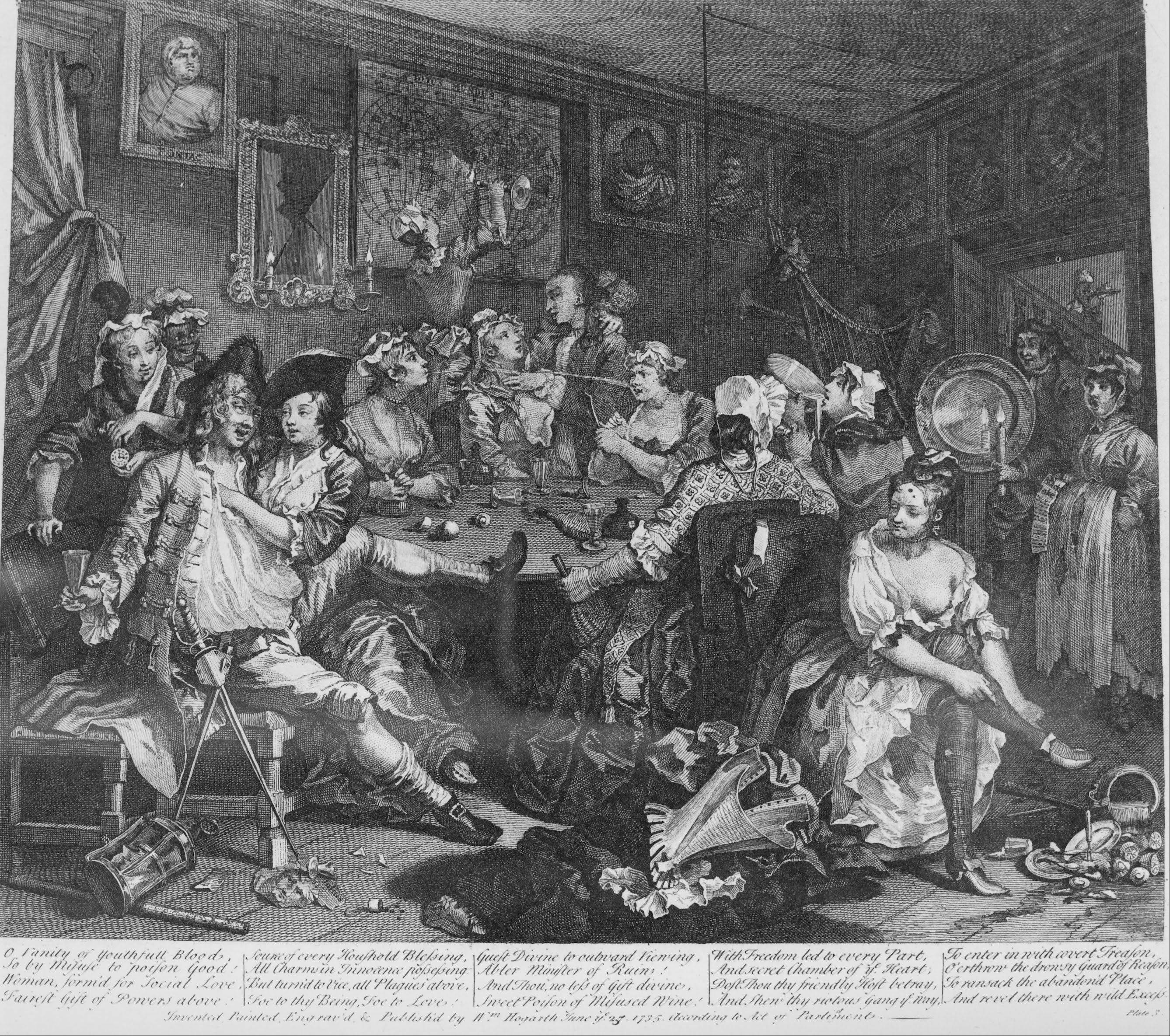
Stravinsky wrote The Rake’s Progress when he was already very successful, writing commissioned pieces for orchestras around the world. So full disclosure: no kick-backs up front. He was inspired by a series of modern moral subjects, by artist William Hogarth, and thought aw, what the heck?
The Rake’s Progress, then, is a cautionary moral tale. Let us begin.
We have Anne Trulove and Tom Rakewell, singing in the garden of Anne’s father’s country estate. Her father has offered to help find Tom a job, but Tom would rather get rich without doing any actual work. He wishes this aloud and, poof! who should appear but Nick Shadow.
Nick tells Tom he has inherited a fortune. Tom hires Nick as a servant and the two go off to London to collect the inheritance. Note the “master” and “servant” irony, if you would, please.
In London, Nick takes Tom to a brothel, run by a madame named Mother Goose. I don’t make this stuff up, people. W.H. Auden and Chester Kallman did. To his credit, Tom resists the charms of the prostitutes, but finally succumbs to Mother Goose. I mean really, who can resist a little Mother Goose at bedtime?
Anne, sensing a disturbance in the force, goes to find him.
Meanwhile, Tom has grown bored with his stint as the prodigal son. He is rich, rich, rich, but still not happy. So he wishes he was happy and, poof again! Up pops Nick. Nick suggests Tom marry the bearded lady, Baba the Turk. Which I’m sure seemed like a good idea at the time?
Anne arrives, but is rejected by Tom. Which is a lucky break for her, I’d say.
Baba the Turk then drives Tom out of his ever-loving mind. He tosses a wig at her to get her to pipe down, which turns her into a statue. I’m sure there’s some kind of symbolism there but it’s beyond me.
With Baba quiet, Tom finally gets some sleep and dreams of a wonderful device. He wakes up and wishes it were true, because with this machine you could make bread out of stones. Get rich quick, scheme, anyone?
It’s even worse than that, because when Nick arrives on the scene to grant his wish, the machine is a fraud (you put in a rock and a loaf of bread comes out the trap door). Tom attempts to sell the machines (to eradicate world hunger, don’t you know), and goes bankrupt when he’s discovered as a humbug.
Insert parallel corporate scandal here.
All of Tom’s belongings are then auctioned off, including Baba.
It’s been a year since Tom first met Nick Shadow, and it’s time for Nick to claim Tom’s soul (what’s left of it). They play a game of cards to see who gets to keep the soul and Tom, trusting Anne’s voice, wins with the Queen of Hearts. Ahhh! Peace and happiness at last!
Except Nick condemns Tom to insanity – which I hardly think is fair. He’s committed to an asylum (the notorious Bedlam asylum, interestingly enough), where he is completely delusional and tries to convince his fellow nut hatches that he’s the Greek god Adonis. According to godchecker.com, Adonis is the “handsome God of Desire and Manly Good Looks. Has a very high squeee! factor.”
Let’s add godchecker.com to the list of random websites I have a new crush on, shall we?
The other inmates don’t believe him, until Anne appears and sings him a lullaby. They all think she’s Venus. And then Tom dies peacefully in his sleep. That’s some singing.
But wait! In case you missed the point, all the main characters come marching out for the Epilogue, and tell us their own version of what the hell happened. Pun intended.
Since it’s Mother’s Day, I asked my very clever daughter if she could think of any operas that have mothers in them. She did not disappoint.
The first opera she came up with was Il Trovatore. The gypsy Azucena stole Manrico from his family, intending to burn him at the stake to avenge her mother, who Manrico’s family burned at the stake. She ends up raising Manrico as her own son because she messed up and accidentally threw her own son into the fire. She ends up getting Manrico killed too, but that takes longer.
The other one she thought of was Iphigenie en Tauride. It was Iphegenie’s father who sacrificed her, so we should probably play this one again in June. Iphegenie’s mother then killed the father. And then her brother killed her mother. Which is a shame because all this time Iphegenie wasn’t even dead.
Agrippina was the ultimate stage mom, maneuvering her son, Nero, into the emperorship. She succeeds, but he kills her anyway – just not in this opera.
And then there’s Medea. She helped Jason get the Golden Fleece and he in turn helped her get rejected by her family. He also fathered her children. And then he went off and married someone else, which Medea wasn’t down with. So she killed his fiancee. And then she killed her kids.
And then there’s poor Salome, who got worked by her mother Herodias. There are several versions – none of them end well. Strauss has Salome killed. Massenet has her kill herself. Either way, it’s her mom’s fault.
Speaking of incest, there’s the whole Siegmund/Sieglinde issue. Siegmund meets Sieglinde and falls in love with her. It turns out she’s his twin sister but that doesn’t stop him from asking his father, Wotan, for help in killing Sieglinde’s husband. Wotan says he’ll help but his wife will never let him hear the end of it if he helps break up the marriage. Brunhilde tries to help too, but gets sent to her room, which is surrounded by a ring of fire. Sieglinde will bare Siegmund a son in the next opera, and, to complicate things, name him Siegfried.
Then of course there’s poor Madama Butterfly who marries Pinkerton, has his child and sits around waiting for years for him to get home from work, only to realize he didn’t really marry her.
Let us not forget the Queen of the Night in Magic Flute. She’s a tricky bugger. And she has a very famous aria.
The nice mom in the mix is Suor Angelica. She’s in a convent because that’s what happens when you accidentally have a baby. One evening her aunt comes to ask her to sign away her inheritance. She’s okay with that, but what she really wants is news of her son – who was taken from her seven years ago. Her aunt breaks the news that her son died two years before.
Alone that evening, Suor Angelica has a vision, in which her son is calling to her from heaven. Being handy with plants, she makes herself a poison and drinks it, thinking they will be reunited in heaven. But as soon as she drinks it, she realizes she committed a sin by killing herself and fears she will not make it to heaven.
As she dies, she sees another vision.
We hope all you mothers don’t get food poisoning from undercooked eggs, or end up in an opera. Wear your noodle necklaces with pride. They go with everything, you know.
For the February broadcast on WOMR I was going to put together a Valentine show but ran into some trouble.
Valentine’s Day is a little rough for opera characters. Mimi, Mario, Violetta, Ernani, Carmen, Manrico, Lucia, Aida, Tristan and Isolde are all dead and most of the others are locked in their rooms writing bad poetry.
And then I thought I’d do a David Bowie tribute show, but my favorite track on Blackstar has a string of f-bombs, none of them subtle but all very catchy. So I thought about an opera that made me think of David Bowie and came up with Monsters of Grace, by Philip Glass.
Now you’re probably thinking I picked Monsters of Grace as a tribute to David Bowie because of Scary Monsters – which is one of my favorites because obviously – but you’d only be partially right. I picked Monsters of Grace because it’s based on the poetry of Rumi, the sufi mystic.
Our new favorite game here is “Bowie or Rumi” – in which you guess who penned the lines (if they even had pens in 13th century Persia). Here are some examples:
Stop the words now.
Open the window in the centre of your chest,
and let the spirits fly in and out.
Or
Wish, and the storm will fade away
Wish again, and you will stand before me while the sky will paint an overture
And trees will play the rhythm of my dream
Are they Bowie, or Rumi?
The New York Times called Monsters of Grace “a work of mysterious possibilities.”
Glass responded to Rumi’s poems which are meditations on the range of human experience: Inspiration for art, companionship and compassion, ruminations on earthly pleasures, questions of heaven, the secrets of life, joy, mortality, recognition of the self and the nature of God.
Sounds like opera.
Music Critic Joshua Kosman writes of Glass: “The deliberate simplicity of his harmonic and rhythmic palette are old news by now, but what’s remarkable is how much depth and emotional force he still manages to wring out of those restricted resources. It’s not just the teasing elusiveness of lines like “Don’t go back to sleep!” that make the music seem as if it’s emerging from a dream state; it’s the hypnotic repetitions of familiar harmonies in unfamiliar guises, which slip right past the listener’s rational apparatus.”
Monsters of Grace is a multimedia chamber opera in 13 short acts directed by Robert Wilson, with music by Philip Glass and libretto from the works of Rumi. The title came from a typo when Wilson used a line from Hamlet: “Angels and ministers of grace defend us!” Auto-correct does it again.
The texts of Monsters of Grace is translated from the Persian by Coleman Barks with John Moyne and AJ Arberry, and the recording was released for Rumi’s 800th birthday.
Because this is radio we mostly talk about the music and libretto, but “Monsters of Grace,” is billed as “A Digital Opera in Three Dimensions.” The opera is made up of 13 unconnected segments, each of which combines computer-generated 3-D visuals. Yes, if you go you get to wear 3d glasses. The music is performed by a seven piece ensemble and four singers.
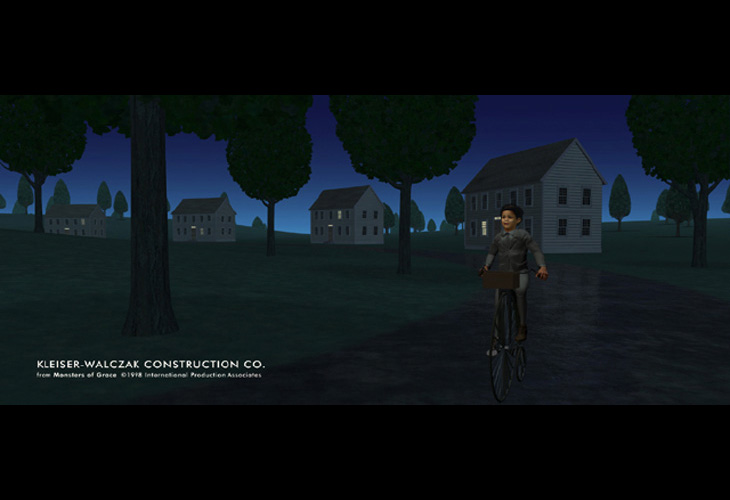
Critic Joshua Kosman goes on to say of the multi media aspect of the performance “Wilson’s most vibrant sequences — including a suburban landscape with a small boy bicycling toward the audience out of the twilight gloom, or a family perched atop an aquatic A-frame house that floats from the tropics to the arctic in the space of three minutes — grip the imagination.
The 3-D effects are used sparingly, but always to splendid effect. The tropical rain forest is home to a large and frighteningly vivid dragonfly, and hands occasionally reach directly into the audience. In the piece’s most exquisite moment, a small songbird flies slowly and gracefully across the center of the auditorium.”
Perhaps the best summation of the piece comes during “Like This,” when the singers intone, “If anyone wonders how Jesus raised the dead, don’t try to explain the miracle. Kiss me on the lips — like this.”
In the liner notes of Monsters of Grace, Philip Glass says “Over the last three years, Bob Wilson and I have been meeting to work on a new theater piece, Monsters of Grace. Since Einstein on the Beach in 76, we have come together on several occasions to make new work, but unlike those projects, with this present work, we have had a real opportunity to sit together and engage in a new world of ideas. Of course image, music and structure are at the root of what we are thinking. We are, moreover, addressing a challenge of a new technology and it’s impact of a developing artistic view. It is fair to say that as an on going process, it is still fluid, elusive, and for us, full of surprise.”— Philip Glass, 1997
While I would love to watch the chamber opera in all its 3D digital splendor, it’s perhaps just as well that this is radio and we only get to listen to Monsters of Grace. In the New York Times, Director and Designer Robert Wilson is quoted as saying “I hated that!” and “It was one of the most embarrassing things in my life.”
It’s safe to say Monsters of Grace is not Einstein on the Beach.
When Monsters of Grace was first produced, in 1998, digital animation wasn’t where it is now. According to the liner notes, this seems to have been the project’s main flaw. It took twenty animators almost a full year to complete the footage based on Robert Wilson’s original intent. Wilson, who has been described as liking to maintain great control over his projects and to change details at the last minute, gradually grew frustrated upon seeing how much time was required to change the animations, and ended up distancing himself from the animators. This led to a final product that, from his standpoint, was unpolished. In an interview with the New York Times, he remarked, “This is like being a dog with a litter of puppies that went away six weeks later. . . . Here I was working with people who didn’t know my work, in a medium I didn’t know.”
I can’t help but wonder what would happen if Wilson had today’s technology to realize his designs.
Bowie or Rumi:
1
Stop the words now.
Open the window in the centre of your chest,
and let the spirits fly in and out.
2
Wish, and the storm will fade away
Wish again, and you will stand before me while the sky will paint an overture
And trees will play the rhythm of my dream
3
Soul love – the priest that tastes the word and
Told of love – and how my God on high is
All love – though reaching up my loneliness
evolves
By the blindness that surrounds him
4
My prayer flies
like a word on a wing
Does my prayer fit in
with your scheme of things?
5
Vision, see nothing I don’t see.
Language, say nothing.
The way the night knows itself with the moon,
be that with me. Be the rose
nearest to the thorn that I am.
6
There’s such a sad love
Deep in your eyes.
A kind of pale jewel
Open and closed
Within your eyes.
I’ll place the sky
Within your eyes.
7
Where do we go to now?
There’s nothing in our eyes
As lonely as a moon
Misty and far away
8
The breeze at dawn has secrets to tell you.
Don’t go back to sleep.
You must ask for what you really want.
Don’t go back to sleep.
People are going back and forth across the door sill
where the two worlds touch.
The door is round and open.
Don’t go back to sleep.
(reprinted by permission from The Magazine of Yoga)
History, repercussions, and desire
BY MAGAZINE COLUMNIST SUSAN BLOOD
I have no idea why I put off my eye exam for so long.
I haven’t read a book in ages. At restaurants I take the menu into the bathroom where there’s better light. My kids have stopped coming to me with splinters and just wait for the school nurse. This is a bummer on weekends.
One day I was proofreading a playbill, squinting, when a full page ad for an optometrist came up. I enlarged the image on my monitor and dialed the number at the bottom of the screen.
Do you know any optometrists? They are lovely.
They give you a comfy chair to sit in and ask you all kinds of questions in an effort to make your life better. They never tell you you’re wrong – how would they know if you were? All the questions are based on how you see things, not how anyone thinks you should see them. Everything should be so simple and ultimately gratifying.
That’s when it hit me: Life is like an eye exam. Trust me, I just had one (an exam, I mean. I’m still working on the life). Every day, every hour we are asked “which one’s clearer? One? Or two?” This is how we go through our days, making strings of choices. Each choice makes the path a little clearer.
Or not. It depends on our choices, obviously.
There is a reason they give you a string of consonants and vowels instead of, say, lines of poetry. Or tax law. We do not attach things to strings of consonants and vowels. We don’t read in consequence or innuendo. We just look at the letters for what they are – blurry or less blurry – until, bing! Things become radiantly clear. At which point we start over.
While life may be like an eye exam, it is not a string of consonants. There’s history and repercussions and desire to consider. Things are complicated in real life! It is not a simple choice between a and b. A and b have an awful lot of baggage. They have attachments. Some of them are scary.
We’d rather not look at them at all, much less see them clearly.
Over the winter I was invited to submit a proposal to a newspaper as a columnist. Having a regular writing gig has been a long time dream and I was, needless to say, out of my mind pleased. Conventional writing wisdom says you have to work your way into being a columnist, taking odd reporting jobs along the way and doing your time. This was a huge opportunity to enter the newspaper world at exactly the point I wanted to end up.
The only problem was, they were looking for a fishing column.
And I don’t fish.
Not only do I not fish, I am incredibly squeamish about things like fish guts. There was no way I was going to become an ace fisherman, or write like one. I agonized for several days, thinking of all the ways I could write a fishing column without ever having to touch a fish. It would be like if the previous columnist had opted to write a column on quilting.
Have you ever noticed you can distill pretty much all your choices down to fear and love?
Look at your motivation and you’ll see. In this case, I was making a fear-based decision. I was afraid that this was the last time an offer like this would come my way. I was afraid I’d miss out on something.
I overcame my fear of not ever being asked to write again with my love of the editor who invited me, and my desire to not get her fired.
I could be wrong because I can’t seem to practice it consistently enough to find out for sure, but I think if all our decisions are love-based instead of fear-based, we make progress faster and find ourselves in less of a blur along the way. Someone please try that and let the rest of us know how it goes.
If this whole scenario had been an eye exam, I would have (pun alert!) seen it clearly. The Optometrist of Life would have said “is this one a good fit?” and when I said “no” the Optometrist of Life (and this is important) would have given me a new set of choices.
Which the Optometrist of Life did
Before long I had a phone call from a theater, asking me to interview as their new director of marketing. I’ve been a long time fan of this theater and love everyone I’ve met who works there. I was a little afraid of how I could make it happen, given the complexity of the rest of my life. I was also nervous about measuring up to their standards. But the thought of working there made me want to skip and sing and hug people, which I think is a good sign.
Once the decision was made, all the pieces fell into place – including finding my optometrist through their playbill. I still find myself wanting to skip at work sometimes, which I couldn’t do all hopped up on Dramamine and wrapped in fishing line.
In my actual-life eye exam, my optometrist told me what glasses to get and said I’d be just fine for a couple years, after which we’d do the whole process again. What was clear yesterday may not work tomorrow. No one wants to stay in the same place for ever. Each time we get to a place of clarity it just gives us a chance to see a little farther and be a little more fearless.
That’s the glory of having so many choices. And so much love with which to make them.






.jpg) Today’s radio show on
Today’s radio show on