Category Archives: Blog Posts

Opera Betty

operabetty-harbor2015Opera Betty  began when the newspaper I wrote an opera column for went belly-up.The demise of the paper and my column are believed unconnected. Recently, the demised paper’s managing editor was busted with $21k in drugs believed for distribution – but that’s nothing compared to what goes down in opera.

The column was geared toward people who read more Spin than Opera News – a fantastically underserved demographic, if you ask me. But no one did ask me, so I started the Opera Betty website.

Radio Betty is the radio version, airing on WOMR the second Sunday of every month at noon, eastern time. I frequently include composers who aren’t dead yet, and talk about the older operas in ways that don’t make you wish you were dead.

I did an interview on Modern-Day Mozartian if you’re curious about what possessed me to do all this.

Opera Betty on Facebook | Opera Betty on Twitter | opera.betty@gmail.com

World’s Best Parenting Trick (and why I hate doing it)

running-for-snacksStupid Facebook.

Someone recently posted one of those “ask your kids these adorable questions about you” things and of course I fell for it. Let me tell you, there are reasons people warn you not to take these quizzes. No, it did not steal my birthdate, blood type and mother’s maiden name. It did something far worse.

It all started a few months ago with the world’s best parenting trick. Seriously. I am a genius. You’re going to wish you had thought of it.

Last fall my son’s soccer coach suggested he get extra running in so he wouldn’t have to stop periodically and look for four leaf clovers. He gets that from me. I have never been a runner, despite frequent attempts. I am a wheezing, gasping, sweaty mess by the end of the driveway. I stop at the end of the driveway because no one in the actual outside world needs to see that.

First I had Studley run around the block, but the block’s not very far and he got bored. Driving alongside him worked until they kicked me off the bike path. And then I remembered Couch to 5k. With Couch to 5k you start with nice long walks speckled with short bits of running. I bought the app, laced up my sneakers and hit the road with my son.

I discovered these truths:

  1. A running partner whose legs are literally half as long as yours is a good thing.
  2. Sixty seconds of running is hideous and nausea-inducing.

I also discovered that people see what they expect to see – and that people are kinder and more generous with their expectations than is reasonable.

What happened: I miraculously kept my whinging to myself with my son trotting alongside.
What people saw: A great and supportive mom, slowing it down for her kid.

I kid you not. People were practically throwing flowers.

I can’t tell you how great this was. Half my problem was how embarrassed I am to plod along in public. Suddenly my snail’s pace was making people’s hearts swell with gratitude for this obvious evidence of kindness and good parenting.

Admiration and approval is very motivational – even if the admiration is founded on a lie. You might think that I’d respond by becoming the mom people mistook me for, but something even better happened: I got to know my boy.

We were both out of breath most of the time – me starting with the tying of the shoes and him after the first spell of running – but I noticed that he was willing to talk while gasping for air, which distracted him from the stopwatch. So I asked him questions. Short, monosyllabic questions.

I learned what was going on in school, what he liked, what he was excited about, what projects he wanted to do, and all sorts of things I still have no idea about but are probably apps. On the trail we could talk about anything and everything.

I asked things like “what’s that?” “what’s it do?” and “tell me more” to keep him going. This will sound ludicrous, but I actually wanted my single-digit aged son to keep talking. I especially tried to get him on a roll when the app was about to say “Let’s Run!” so I could pretend to miss the cue.

He always heard it, and we ran.

We ran for six weeks and made a lot of progress, staying with the program despite the voice in my head telling me we were going to die. And then the weather changed and I had to beg out because who knew cold air burns the lungs like freaking acid?

After a couple weeks of waiting for the searing to stop, I decided I was off the hook and could give up running with a clear conscience. I had given it a good and valiant effort. Soccer season was over and so was I.

And then that stupid Facebook thing happened.

Months after we stopped, his answer to “What do you enjoy doing with me?” was still “running.” And not “running for the best spot on the couch to watch Mythbusters,” either.

For extra guilt-inducing credit, his answer to “what makes me happy” was “me.” Remind me of this when I’m gasping for air on the next non-sub-zero day, running at a pace slightly slower than a brisk walk.

I don’t know why he likes running with me. I am whiny, slow and probably unfashionable.
But I suppose it must be done. The entire town must be worried sick, wondering what happened to that darling little jogger boy and the best mom ever.

And he’s right – he is what makes me happy.

Maybe – somewhere under all the wheezing – I really am the mom people mistook me for.

If you have any tips on how you can run in cold weather and not cough up a lung, I’d appreciate them.

Just don’t post them of Facebook.

Opera Betty: La Traviata


La Traviata, as it turns out, means “The Lost One.” This is news to me as I always thought it was a derivation of the verb travailler and had something to do with a working girl. Which would make sense since, as we have previously discussed, a courtesan is a high class working girl.

There’s heaps to like about La Traviata. Operas with courtesans always have great costumes and fancy sets and this one is no exception. Also, someone dies in the end and I do love an opera where someone dies.

The people you need to concern yourself with here are:

  • Violetta – the title character
  • Alfredo Germont – the guy who falls in love with her and whisks her out of courtesanness, kind of like in that Police song or Pretty Woman, if you will
  • Flora – Violetta’s friend
  • Annina – Violetta’s maid
  • Giorgio Germont – Alfredo’s father, (they just call him Germont)
  • Baron Douphol – Violetta’s escort before Alfredo came along

The opera starts with a prelude that is, like many preludes, a clip show of what’s to come – specifically, the love theme and the somebody’s-going-to-die theme. The word on the street is that the prelude is the last bit to be written. Composers are reported to knock them out just as the orchestra is tuning up, wondering where their music is. They can do this because preludes are an assemblage of the Big Smash Hits they’ve already written in the opera. So. The sad violins are the dying theme and the happy violins are the love theme. Moving on.

Act I

A party at Violetta’s house. At this party she’s introduced to Alfredo, who has been charmingly stalking her for the last year. She had been sick (still is – it’s consumption and did I already say she dies at the end? Spoiler alert), and he’s come every day to check on her. He arrives to the chagrin of Baron Douphol who is Violetta’s escort. The baron has not checked on her every day because, well, he’s not supposed to be likeable. After a bit of chit-chat (which in operaese is called “recitative“), Alfredo sings a drinking song. Who doesn’t like a good drinking song?

Alfredo tells Violetta he loves her. She tells him not to bother. They go on like this for quite some time. And then she tells him to go away, but to come back tomorrow. After he leaves, Violetta sings about how swell it would be to fall in love and have someone love her back. And then she decides she’s really meant for the courtesan life after all.

Alfredo is heard singing outside her window, which changes Violetta’s mind briefly, but then she’s all back to living the high life. No way no how will she leave all this for love.

Act II

She has left it all for love. Violetta and Alfredo have been living outside Paris for three months in unwedded bliss and are running out of money. Alfredo discovers this when he talks to Annina, who tells him Violetta has gone to Paris to sell her stuff and pay their bills. Alfredo is horrified and goes to Paris to get the money himself. There are no details as to how he plans to accomplish this. Maybe he learned a thing or two from Violetta?

While he is gone, Violetta comes back. And then Alfredo’s father, Germont, arrives. Germont asks Violetta to leave Alfredo because her reputation is tarnishing the family name. As long as she remains, says Germont, Alfredo’s sister cannot marry her fiance. It’s complicated. When Violetta waffles a bit, Germont throws in the zinger that when she gets old and saggy, Alfredo will probably leave her anyway. Violetta agrees and writes a letter to Alfredo. She goes to Paris and leaves Germont to deal with Alfredo.

Alfredo comes home and receives Violetta’s letter just after she leaves. He also finds a discarded invitation to a party at Flora’s house, so he storms off to Paris to find Violetta.

Violetta does indeed show up at Flora’s party, with the Baron. Alfredo arrives and proceeds to school the Baron at cards. He wins a pile of cash, enough to pay their debts. Dinner is served, but Violetta asks Alfredo to stay back so she can talk to him. She doesn’t explain what happened, just warns him that the Baron will probably try to provoke a duel. Alfredo kind of loses it a little and calls everyone back into the room. He tells them all how she sold everything and, throwing his winnings at her, declares that he’s paid her back. And then he sings to himself  “Ah si! Che feci! No sento orrore!” which is Italian for “wow, I’m a total asshat.”

Act III

Violetta is dying. She’s at her house, which is not such a party these days. She’s attended to by Annina and visited by the doctor, who has quietly told Annina she doesn’t have long to live. Violetta, I mean. Annina’s fine.

At the last possible minute, Alfredo shows up – having been told everything by his father. They sing to each other and Violetta suddenly announces that she feels better. Oh happy day! And then she dies. More sad violin music.

The end.

I have a radio show on opera for people who hate opera on WOMR. Opera Betty is at noon eastern time on the 2nd Sunday of the month.

mess

I may have freaked out a little. If you looked around our house (which I will not permit), you would understand. It’s a disaster. There’s an outlet lying on the dining room floor. An empty Tupperware on the kitchen floor. A sock here, a dryer ball there, and all manner of whatnot in between. Every room is covered with abandoned stuff – none of which makes any sense.

“This is not how people who like their homes behave,” I said. “It looks like no one cares about the house.”

Sugarplum, who is the most neat-wired of the family, agreed. But then she said, “those houses where nothing is out of place look like no one cares, too. It’s like no one lives there.”

She stresses “lives.”

She inventories the infringements: no mail on the dining room table, no piles on the stairs, etc. “It’s kind of creepy,” she concluded. This is a problem with which we are unfamiliar.

Honestly, I don’t even know where she saw a house like that. If it’s your house and she came over to visit your kid, we can’t be friends anymore.

She has a point, though, and I need to remember that “lived in” is not always a euphemism for a giant pile of domestic rubble. We do, after all, live here. We love our house and – as far as we can tell – our house loves us. It holds our mail, catches our crumbs and lets us sort laundry in the hall. When we’re busy, it serves as a launching pad. When we’re tired, it gives us shelter.

Our house is like a mom – grabbing our lunch box after school, handing us our cleats, and telling us to have fun as we run off again without a backward glance. Sometimes it has stains on its shirt and is still wearing slippers as it stands waving at the door. It may also have forgotten to shower. These things happen. They don’t mean we appreciate it less. If anything, we appreciate it more.

Not every night can be bath night. Not every day is fresh-laundry-folded-and-put-away day. Our house looks put together when it wants to, but it has neither time nor patience for a wash and set.

Maybe when life is less hectic, our house will be tidy. Mail will be sorted at the door. No one will trip over sports equipment in the dining room. It will be dressed and made up, ready to change out of slippers to greet company at a moment’s notice.

But even then, I hope it never looses the feeling that all are welcome. That it’s okay to dump what you don’t need, grab what you do, and go live. I hope there are signs of life. It would be awfully lonely otherwise.

Everyone has their own place of comfort – probably somewhere between “social services needs to intervene” and “Stepford Wives.” For us – right now – the place of comfort is “clean on bath night.”

For us, baths are best when you’ve earned them.

Unconditional love (and no mice)

“Is she a rescue?” people ask.

This is one of those questions that makes you a hero if you answer properly. I don’t know what it does if you don’t.

A month ago we met a greyhound and realized she had been missing from our lives. She needed a home. We have a home. It was that simple. Zelda is now part of our family. She is gentle with the kids and has not eaten the cat (which some consider a failing).

I know the plight of greyhounds, but I cannot in all honesty say that I rescued her. It’s much more selfish than that. It feels like someone was giving out pots of rainbow gold and we happened to be the first caller.

Furthermore, the word “rescue” does not suit her. Zelda is not so much rescued as retired. She had an illustrious career on the racetrack and now has retired to the country.

She has a keen interest in ornithology, has joined the local garden club and is considering Celtic harp lessons. She hasn’t told me she wants harp lessons but I did find the Adult Continuing Education catalog in her bed with the Celtic Harp page torn out.

Conclusions were drawn.

Having a dog is a new experience for us. Over the years we’ve become very pragmatic. We have chickens who lay eggs. We have a cat who is supposed to keep the mouse population to a dull roar. We’ve considered a goat.

We love our friends’ dogs, but didn’t see how it made sense for us. Big bags of food, an obligation to walk and responsibility for another life did not add up to a good idea.

Having no reason to get a dog, and no compelling justification for one, we have been dogless all these years.

Needing a reason is highly overrated.

When the dog moved in, the mouse population moved out – something we thought might happen during the cat’s 12 year tenure. There was not a lot of hoopla. There were no headless rodents in the middle of the floor. They just moved.

Perhaps they felt outclassed. In the last month, Zelda has added an element of grace to our home and our family. I feel like English nobility when I walk her. She is elegant, gentle and graceful. And that’s just the external bit. She has given the kids a sense of responsibility. She encourages us to take walks as a family.

We do things for Zelda that we don’t do for ourselves. Love does that.

Adding grace and kindness to a home is at least as practical as backyard chickens. When did we become so pragmatic? At what point did we start needing to see a tangible benefit to things?

It turns out there is a tangible benefit after all. When you invite in qualities of grace and unconditional love, they take up lodging in the most unexpected places. Everywhere you look, you see their blessing.

Neighbors are kinder. Children are more thoughtful. Your own heart feels lighter.

That’s at least as good as scrambled eggs, and absolutely worth the price of Celtic harp lessons.

This column originally appeared in The Magazine of Yoga

The Apocalypse (or, if you prefer, Thursday)

lightening8am
Chris says the ground opened, which is what it feels like. Most of the lights don’t work and the house smells like melted appliances. The ground opened, and in we fell. I didn’t think this was supposed to happen until December.

Electricity is coming into the house at 220 because the ground wire went down in the latest storm onslaught. That’s not a good thing.

We’re not sure what survived, appliance-wise. When we open the refrigerator it looks like an alien spaceship is coming at us. (I mean the light, not the leftovers.) The kids are psyched because first everything was dark and then, just as they were done getting ready for school by flashlight, the house went into Demonic Possession mode. They’d flip a switch in one room, and a light would come on in another. It was awesome. I could barely get them out the door.

Meanwhile, back at the ranch, my mother-in-law has short term memory loss so we’ve been over what’s going on a million times in the last 15 minutes.

Note: There is something uniquely horrible about not knowing what’s going on and having to tell someone the specifics of what you don’t know and have no power over, repeatedly.

We started with the long story, and then moved to the abbreviated version:

“There’s no power.”

“Is someone going to make me some toast?”

(Rinse. Repeat.)

I think if we stabbed a piece of bread with a fork and then stuck the end of the fork in an outlet, it just might work.

NSTAR deemed it dangerous and advised us to throw the main breaker until they could send a crew.

(Long pause in which we wait and then give up, going to bed at 9 because what else are we supposed to do? There’s no internet and I am all caught up on my counted cross stitch by candlelight.)

10pm
I wake up to an authoritative knock on the door. A tall, handsome NSTAR man is in my garden. Behind him, my lawn is crawling with utility workers in foul weather gear.

You don’t realize how many windows you have until you are sitting in total darkness, with searchlights bouncing off every wall in your house from outside. It’s like a movie. Let me just say that I really hope the people who are inches from my windows, scaling my walls and shining searchlights all over my lawn in the dark of night are always using their power for good, not evil.

If the neighbors ask what all the search lights were for, I’m going to tell them Sugarplum lost her gerbil.

Appliance death-toll to come. Stay tuned.

P.S. Thank you, NSTAR

(updated)
Death Toll: furnace, oven, toaster, coffee maker, mother-in-law’s radio, assorted lights…. (still taking inventory)

Opera Betty: The Metropolitan Opera, Live in HD – 2012/13 season overview

People are always asking me which of the upcoming Met Opera HD broadcasts they should go to, and what they’re all about. So I thought it would be helpful to list the upcoming operas with extraordinarily helpful information about each.

Check the Met’s website before setting your heart on anything. Opera’s fickle.

Live in HD – The Metropolitan Opera’s 2012/13 Season:

Donizetti’s L’Elisir d’Amore–New Production
October 13, 2012
Nemorino buys a potion from a quack doctor, thinking that when he drinks it he will be able to talk to Adina and she will fall in love with him. He ends up drunk, but lucky for him, he’s adorable when drunk. It all works out. The end.

Verdi’s Otello
October 27, 2012
In which Otello seems smart but gets played like a … like a… like a tenor in a Shakespearean opera by Verdi. (You don’t get more played than that.)

Adès’s The Tempest—Met Premiere
November 10, 2012
Simon Keenlyside is Prospero and is dreamy. The end. (Okay yes, it is also directed by Robert LePage, who did the Met’s new Ring cycle. Let’s face it, if Robert LePage directed The True Story of Mary and Her Little Lamb, I’d go see it.)

Mozart’s La Clemenza di Tito
December 1, 2012
In which Titus’ fiancee and his friend plot to kill him. Titus, in turn, clemenzas them. It’s gripping.

Verdi’s Un Ballo in Maschera—New Production
December 8, 2012
If you laugh off a fortune-teller’s prophesy of your own doom, stay away from masked balls. Especially if you find yourself in an opera.

Verdi’s Aida
December 15, 2012
Princess wars! An Ethiopian princess and an Egyptian princess duke it out over our hero Radamès. One of them wins – if by “wins” you mean “dies.”

Berlioz’s Les Troyens
January 5, 2013
With approximately 52k square feet of stage (if you count the side and rear stages), the Met could probably stage the actual Trojan War. This is close.

Donizetti’s Maria Stuarda—Met Premiere
January 19, 2013
Mary Queen of Scots is doomed, doomed, doomed, but she gets to spend her final hours in an opera directed by David McVicar so at least she’ll go out in style.

Verdi’s Rigoletto– New Production
February 16, 2013
It’s like the regular Rigoletto, but set in Las Vegas circa 1960.

Wagner’s Parsifal–New Production
March 2, 2013
It wouldn’t be a Wagnerian opera without Knights of the Holy Grail, a biblical spear, a bunch of curses, a magical villain, some prophesies and a dashing hero.

Zandonai’s Francesca da Rimini
March 16, 2013, 12 pm ET
It’s inspired by Dante’s Inferno, which is funny since most of my friends equate opera with one of the rings of hell.

Handel’s Giulio Cesare—New Production
April 27, 2013
Handel has a thing for casting the roles of people like Julius Caesar and Nero as countertenors. Hilarious. Have you ever heard a countertenor? You’ll fall off your chair the first time he opens his mouth.

New Operas – Radio Betty Episode 17

In Episode 17 we talked about the abundance of new operas, including Guerilla Opera’s world premiere of “Loose, Wet, Perforated.” I went to see “Heart of a Dog” last winter and can affirm that you will never see anything like a Guerilla Opera production. For ticket info, go to guerillaopera.com.

We also talked about Kickstarter and all the operas in varying states of production. If you haven’t been to kickstarter.com yet, set aside a few days with no distractions and plenty of food and water. The projects people have come up with are unbelievable. I searched for “opera” and found 134 projects. Some were already funded and some had not met their goal (thankfully, in a few cases). Many are still collecting donations, including “Beautiful Creatures,” the first opera that caught my eye. According to the Kickstarter overview it “explores the loss of ideals and how we reconcile our best hopes with sobering realities.”

I was pulled in by the music during the video introduction, and then realized I recognized one of the faces: playwright Dominic Orlando. I never seem to discover someone is a librettist until long after I’ve spent a week hanging out down the hall from him. I worked on the publicity for Dominic’s play Danny Casolaro Died for You, which premiered last fall (what do you mean you haven’t heard of it?? You have now). I love his storytelling and pretty much think he’s the cat’s pajamas. In fact, if I didn’t like opera, this might push me over the edge.

The synopsis: Eileen, an inveterate executive of an environmental organization, struggles to find the reins of her mission in the green movement with all its recent changes. Her fantasies and anxieties play out during an afterparty at a green conference where the competing strategies and motivations of 3 other characters within the movement (a celebrity, an eco-terrorist, a green-washed corporate) threaten to take them all down.

After the guests have arrived Cori (the terrorist) tells us that she’s wearing a bomb, and intends to kill the tabloid beauty (Hank) to demonstrate the destruction of a “beautiful creature” she believes the world won’t ignore. Stan and Eileen get into a row about their old relationship: he accuses her of becoming a shameless self-promoter posing as a green activist. She chastizes his corporate greenwash activities for clean coal. Cori confronts Hank to see if he might have any real integrity about the environment, but remains unconvinced by his response. International activists stroke Hank’s ego in order to leverage his celebrity, but Stan makes an ugly scene, telling them he’s just an actor posing as a do-gooder. Cori finally gets herself psyched up to do the deed even while she’s wishing someone might stop her. The others struggle in a build-up to a tense moment where the bomb might go off.

Stage|Time Collaborative has until October 2 to reach their goal. Donate here if you can:BEAUTIFUL CREATURES.

From there we gave an overview/tutorial on The Rake’s Progress. It seemed appropriate.

And for the Ripped from the Headlines portion of our program, we talked about Eva-Maria Westbroek and her roles as Anna Nicole and Sieglinde. Interestingly, if you do a google search for images of Eva-Maria, there are about 80 billion of her as Anna Nicole and 12 as Sieglinde.

Read the article in The Independent.

In addition to segments of the operas, we played “Boycott Immorality” from Chocolat and “Anna Nicole Smith’s Baby” by Spring Forth. We tried to fit in Bananarama’s “Venus” at the end of The Rake’s Progress, but it was too jarring a transition even for us.

Next time.

Elo, experienced

We don’t do ballet reviews here at Opera Betty because that would make us ballet bettys, which we’re not. However, we can’t get Boston Ballet’s Elo Experience* out of our heads.

Boston Ballet this season has been reminding me of the Red Sox the year they broke the curse and won the World Series. For those of you unfamiliar with the Red Sox Curse, in 1920 the Red Sox sold Babe Ruth to the Yankees. As he left town, Babe Ruth said “next season you will prick your finger on a spindle and DIE!” but the Red Sox’ fairy god mother had not yet given the Red Sox their birthday wish and said “you will not die, but you’ll lose for almost a hundred years and perhaps wish you were dead.”

In 2004, they won the World Series and there was much rejoicing.

That season, they were especially fun to watch because they a) didn’t lose and b) were just plain fun to watch. They spoke their own language – like “cowboy up” and “Manny being Manny.” They had goofy little inside jokes and pranks.

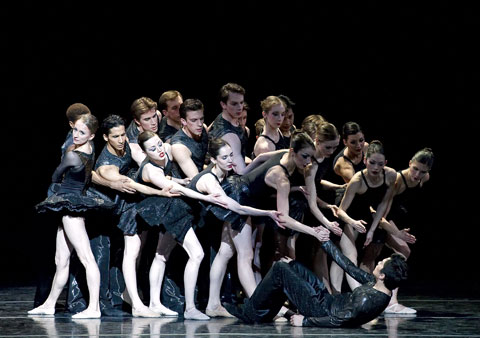
I don’t know if Boston Ballet is prone to inside jokes and pranks, but I do think they speak their own language. Characteristic turns of phrase and figures of speech that identify each dancer are the language of a company. This is what Jorma Elo translated into dance in Elo Experience.

Which doesn’t mean I understood what they were saying. Some of these pieces are like poetry – where you read it and feel it but can’t explain what it’s about. There were times when I felt like I was dreaming. There were moments of deja vu where I struggled between recalling previous Elo choreography and wondering if he had tapped into something archetypal. If it’s possible for something visual to hit emotional pressure points, Elo does it.

While the story ballets are classic favorites and heaps of fun to watch, the company is brilliant with more lyrical, contemporary choreography. They dance in silence with sharp stops and undulating gestures. They are subtle and ephemeral. They are technically the tightest and most inspired I’ve seen in years.

At opening night of Elo Experience, there were two things we hadn’t seen before.

1) With intermission house lights still on and no warning, the dancers appeared on stage, nonchalant as anything. It was a surreal peek at the underpinnings.

2) After the final bows were taken we heard a cheer behind the curtain – presumably the company applauding their resident choreographer.

And rightly so. He speaks their language.

*not the band

Radio Betty – episode 12

I got all excited when I saw Susanna Phillips was singing in Boston Lyric Opera’s A Midsummer Night’s Dream. I was this close to her backstage at the Met. We… you know…. hung out.

Except she was in the middle of singing La Bohème so we didn’t get to chat much.

And then I was talking to my new best friend at Modern Day Mozartian, and she asked me about cross-overs, which made me think of Renée Fleming and Matt Haimovitz. Matt doesn’t play opera, but I didn’t let that stop me from throwing him into the fray. I also wanted to get some Wynton Marsalis in and lo and behold I have him on a track with Kathleen Battle. Which absolutely counts. Here’s the playlist:

  • “O Sole Mio” Redneck Tenors, 3 Redneck Tenors – A New Musical Adventure
  • “Sunday Songs: I. Oriole” Susanna Phillips, Wheeler: Wasting the Night: Songs
  • “Isolde!/Tristan! Geliebter!” Wagner: Tristan und Isolde – Placido Domingo/Nina Stemme/René Pape/Mihoko Fujimura/Olaf Bär/Jared Holt/Matthew Rose/Rolando Villazon/Orchestra of the Royal Opera House, Covent Garden/Chorus of the Royal Opera House, Covent Garden/Antonio Pappano
  • “Mild und leise wie er lächelt” Wagner: Tristan und Isolde –  Dame Joan SutherlandLa Stupenda – The Supreme Joan Sutherland
  • “Soul Meets Body” Renée Fleming Dark Hope
  • “You Are A Tourist” Death Cab for Cutie Codes and Keys
  • “Figlude” Matt Haimovitz Figment
  • “Baboon Tribe” Stewart Copeland Orchestralli
  • “Let The Bright Seraphim” Handel: Samson,  Wynton Marsalis, Kathleen Battle, Anthony Newman, John Nelson; Orchestra Of St. Luke’s
  • “Quando Men Vo” Puccini – La Bohème – Mirella Freni, Luciano Pavarotti, Karajan

I was on a Tristan und Isolde kick because I just finished The Metropolis Case by Matthew Gallaway. There’s a lot of sex in it, so don’t read it if you’re my mother. There’s a lot of opera, too (and opera sex). AND there’s a lot about the Velvet Underground and My Bloody Valentine and Hüsker Dü and heaps of other bands I like.

See, honey? It’s not just me.

Huge thanks to Sonic Trout for gluing it all together and sprinkling it with fairy dust and sequins. And hugest thanks to WOMR for airing it every month. You can listen live online at www.womr.org on the second Sunday of every month at the stroke of noon.

Wear your pajamas. I do.

Opera Betty: Agrippina

When Nerone opens his mouth in Agrippina, you understand what happened to the Roman Empire.

Nerone is failing to launch. He lounges around in purple satin pajamas, annoying the staff and toying with lighting his mother on fire when word comes that his stepfather, Claudio, has died.

This is the beginning of Boston Lyric Opera’s Agrippina, by George Frideric Handel. From the audience’s perspective, Nerone is hardly throne fodder.

Agrippina (Caroline Worra) wants her petulant, spoiled, coke-addled son to be Emperor. As Nerone, David Trudgen minces, prances, swills (and snorts) elaborately. From the previews, I was afraid he was too grown up for the role. Was I ever wrong. He is every bit the annoying adolescent.

Agrippina enlists the help of Narciso (José Álvarez) and Pallante (David McFerrin) to help her get Nerone proclaimed Emperor. Just as she succeeds, word comes that Ottone (Anthony Roth Costanzo) saved Claudio (Christian Van Horn) and they are on their way home. To make matters worse, Claudio has named Ottone as his successor. This is not part of Agrippina’s game plan.

All three countertenors, David Trudgen, Anthony Roth Costanzo and José Álvarez, played their roles beautifully. You don’t hear countertenors every day, and yet I can’t imagine this opera without them. The vocal range is part of Handel’s wit. It’s just so…improbable.

While Nerone and Narciso are comic characters, Othone is the hero/victim. My friend whispered, “if Poppea doesn’t want Ottone, I’ll take him.” And who could blame her? Anthony Roth Costanzo, in his BLO debut, is the opera’s most likeable character with one of the sweetest voices.

Unfortunately for my friend, Poppea (Kathleen Kim) does want Ottone. She does not want Claudio and Nerone, who do want her. None of this is especially palatable to Agrippina, who uses Poppea as bait in her scheme.

As Poppea (and in general) Kathleen Kim is a woman to watch. “She’s delightful,” said the woman behind me. “What a show stealer.” I had to agree. I just saw her in New York as Chiang Ch’ing in the Met’s Nixon in China and couldn’t believe my luck at seeing her again in Boston. Kim pulled us out of our self-conscious chortles and made us laugh out loud with her character acting. The only thing better than watching her is listening to her.

Agrippina’s scheme does not work. Poppea’s does. Things get ever more complicated and convoluted as people chase and deceive one another. The antics escalate – people dive under beds and spring out of closets – until the scheming caves in on itself and we are left with a man who wants a throne and another man who wants a wife.

The costumes by Jess Goldstein are wonderful, gliding in and out of period. The characters do not play by the rules, and neither does the costuming – originally created for Glimmerglas Opera and New York City Opera.

Even the props are funny. Now that the Handel-spiked punch has worn off, I can’t say what tickled me about a painting gliding along the back of the stage on its own volition. It just did. The story snowballs until every gesture, every nuance, every out-of-context skull on a platter is inexplicably funny.

There are a few gorgeous arias that reel it back in, including Agrippina’s tender “Se vuoi pace” in Act 3. For all her antics, this is where Caroline Worra really shines.

It would be a tragedy if it weren’t hilarious. Even in its tragic moments, it winks and reminds us it is, at heart, a farce.

The tip-off is the relentlessly light-hearted Baroque orchestra. And what an orchestra. Gary Thor Wedow conducted the Boston Lyric Opera Orchestra and five-piece continuo group of period instruments. Harpsichord, theorbo, and virginals join recorder, strings, oboe, bassoon, trumpet and timpani. Where the set is simple and soaring, the orchestra is ornate and delicate. It fills in cracks and sweeps in and around the debauchery and deceit, unphased by the trickery on stage.

Throughout it all, a silent chorus provides commentary and atmosphere – peeking around walls and disappearing into shadows. Set designer John Conklin and Lighting Designer Robert Wierzel did a splendid job of keeping it simple overall, making the over-the-top elements really shine. Projected English titles were by Kelley Rourke.

A word about subtitles. The physical comedy in Agrippina makes subtitles hardly necessary. They are helpful to check in with, but not mission critical – until the end. Please, for the love of Caesar, read the subtitles at the end. Hilarious.

I give Agrippina three busts of Claudio and two laurels (that’s very, very good).

(You can read my significantly longer-winded review on www.bachtrack.com.)
Opera Betty Goes To New York!

If I call it a company retreat on the internet, can I claim it as a tax deduction?

We went to New York for the week and saw as much opera at the Met as humanly possible without waiting for them to open Iphigenie.  They treated us incredibly well. And now we have to brag a little.

Nixon in China
First I should say that from here on out I’ll say “we” but I mean “I” because when something fabulous was offered I jumped at it and left the junior staffers in the dust. They had their moment – I just had more. Let’s try this again.

Nixon in China
On Saturday we saw Nixon in China which is good because we took our kids/staff out of school before school vacation so we could get to New York in time for Nixon. I really, really hope their teachers don’t read this.  Still it didn’t occur to me that John Adams (I love John Adams) would be conducting it. Of course John Adams was conducting it.

My editor (not here, this is not her fault) was stage managing the night we went. I had visions of her looking at the monitor and seeing my face appear above the wall that separates the orchestra from the general public. I like to think that she would not have expected to see me stage diving the pit.

It’s possible she expected that, which would explain the additional security.

La Bohème
I didn’t see La Bohème very well because I watched it from the wings (tra la!). I also missed parts of it entirely because I was running around making sure Mimi’s key was in the right place and stalling Musetta in the wings so she couldn’t get to Mimi in time with the medicine.

That last bit is not exactly true – although Musetta (Susanna Phillips) did stand right behind me and seemed very nice and like the sort of person who would sell her earrings to save your life if need be.

Marco Armiliato smiled at me quite by accident but I will remember it forever nonetheless.

At first intermission the junior staff members came backstage to watch the scene change and were each given a handful of Act III snow. Note: people who say opera is snobby have not met the people who work backstage. People in the house sometimes need to get over themselves, but the ones who make it all happen are the cat’s pajamas.

I got to pet the horse and the donkey and ate a cookie out of the Act II cookie jar. Don’t tell anyone.

My life mission is now to start as many sentences as possible with “this one time, backstage at the Met….”

Don Pasquale
The last time I saw Anna Netrebko in something it was Lucia di Lammermoor. Lucia is almost exactly like Don Pasquale in that she wants to marry someone and someone else is not letting her. The difference is that in Don Pasquale she smashes things and then redecorates and in Lucia she kills someone and then dies. I liked her in both.

You know what else I like? Sitting in box seats. The boxes have their own coatrooms. We sat in the parterre for Don Pasquale and I really think it made it sound better.

“I could get used to this,” I said to the Opera Betty CFO.

“No,” he said. “No you can’t.”

He also thought the plot was “far-fetched” which… oh please.

I learned some important things about opera while I was there – specifically, that you can order dessert ahead of time and be seated in the Met restaurant during intermission. We didn’t do this but only because we’re idiots.

I also learned that my daughter and I are not the only ones to get sucked into American Girl Place and spat out on 5th Avenue. I had a nice chat with the radio broadcast coordinator and she knows all about these things.

Opera people, after all, are people too. They just get to smash things.